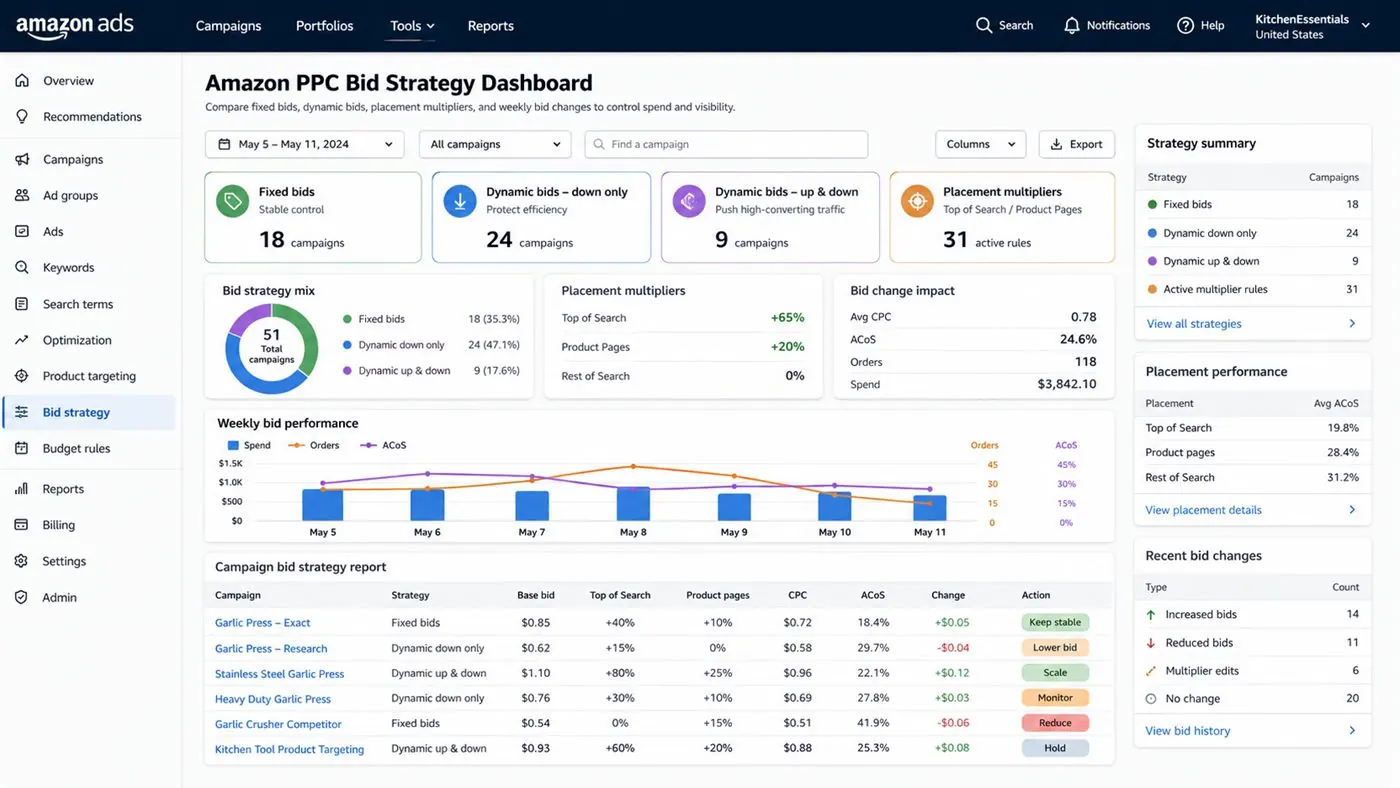
Amazon PPC Bid Strategy: step-by-step method
Use this method to make amazon ppc bid strategy easier to execute, report, audit, and improve every week. The aim is to move from raw Amazon Ads data to a written action list: what to protect, what to reduce, what to test, and what to review again.
- 1. Map purpose: Every campaign needs a job.
- 2. Group campaigns: Organize by product and role.
- 3. Set naming rules: Make reports easier to read.
- 4. Check budgets: Protect priority campaigns.
- 5. Review reports: Measure what changed.
- 6. Write actions: Make next steps clear.
- 7. Repeat weekly: Consistency beats random fixes.
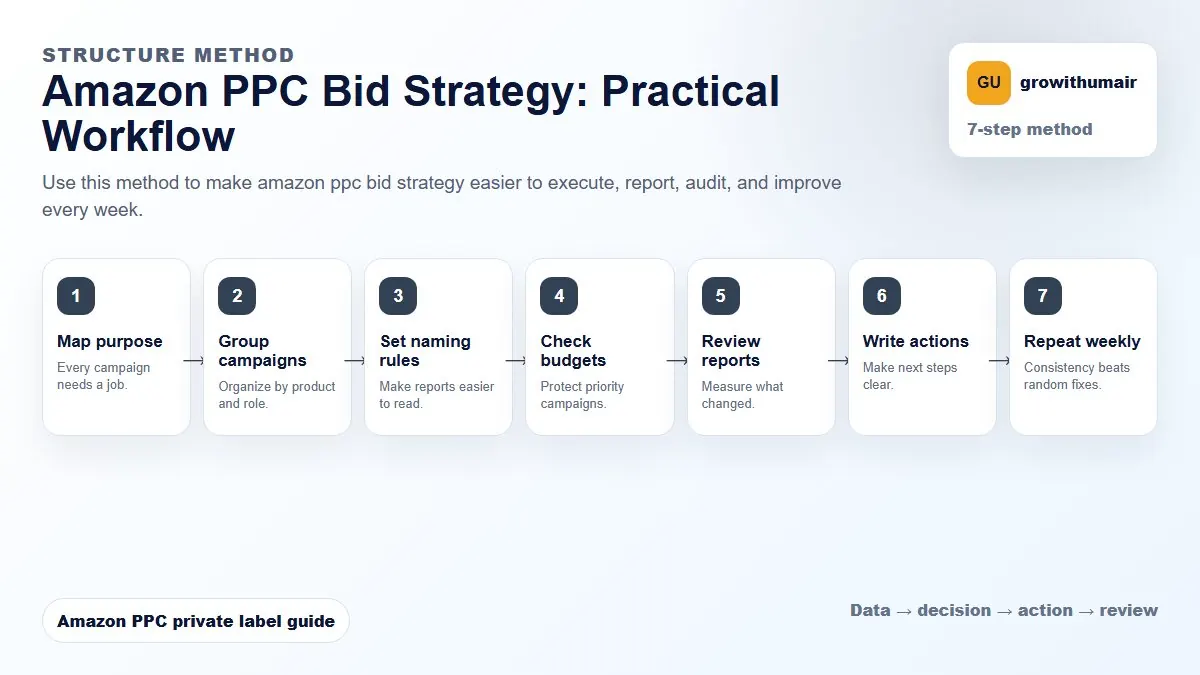
How to choose the next action
Do not treat one metric as the whole answer. For every change, read the metric beside campaign purpose, search intent, listing readiness, rank movement, and profit. This prevents cutting useful traffic just because one report looks uncomfortable.
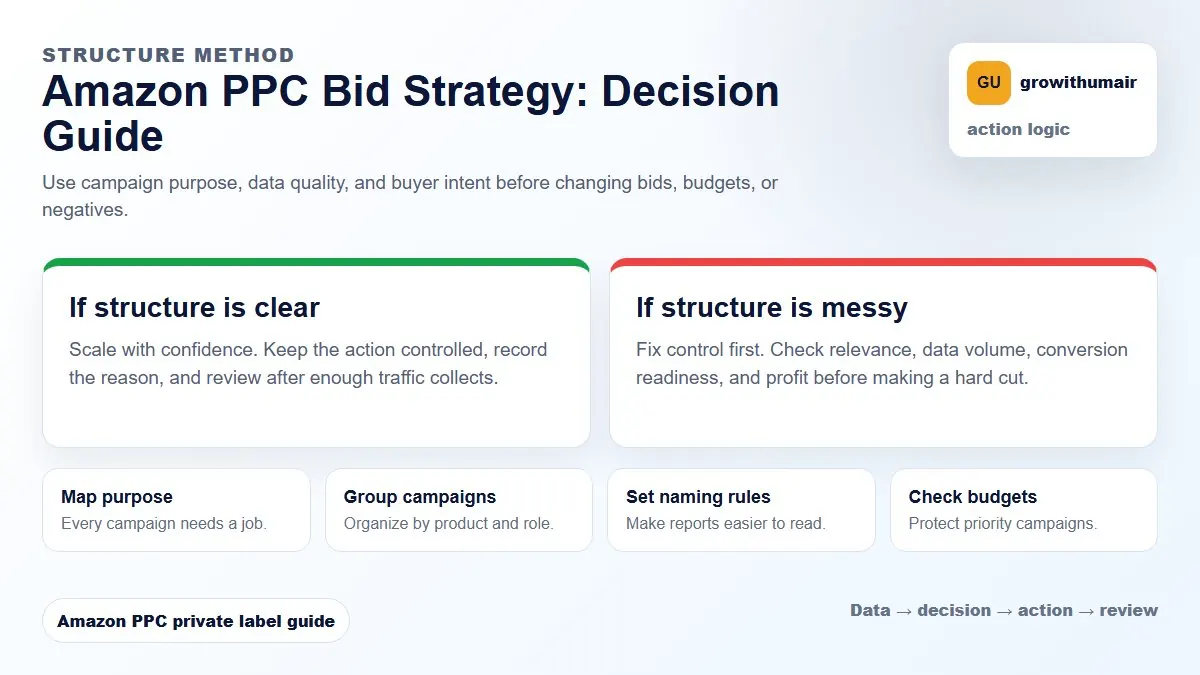
Bid strategy by launch stage vs mature product
A new product and a mature product should not use the same bid logic. During launch, the account may need higher bids, tighter keyword selection, and stronger Top of Search visibility to generate early sales velocity. The goal is not only low CPC; the goal is to collect conversion data and support ranking on the right terms.
For a mature product with stable organic rank, the bid strategy should become more defensive. Protect exact winners, reduce waste in broad and auto discovery, and avoid paying for clicks that organic rank can already capture. Mature products should usually be managed with tighter target ACoS ranges and clearer placement limits.
Sponsored Brands need different bid logic
Sponsored Brands placements behave differently from Sponsored Products. They can support brand visibility, storefront traffic, and category awareness, but they often need separate targets because shopper intent is not the same. Do not copy Sponsored Products bids into Sponsored Brands without checking CTR, branded vs non-branded terms, and new-to-brand value.
Amazon PPC bid strategy comparison
| Bid strategy | Use when | Avoid when |
|---|---|---|
| Fixed bids | You need stable control for exact winners, ranking terms, or brand defense. | The campaign is broad research with weak conversion data. |
| Dynamic bids down only | You want Amazon to reduce bids when conversion probability is weaker. | You need aggressive launch visibility and consistent impression share. |
| Dynamic bids up and down | You have proven conversion and can tolerate higher auction cost. | Margins are tight or you do not know break-even CPC. |
Amazon PPC bid strategy FAQ
Should I use fixed or dynamic bids for ranking campaigns?
Fixed bids with intentional placement multipliers are often cleaner for ranking campaigns because they give more control over impression share and CPC.
How often should Amazon PPC bids be changed?
For active campaigns, review bids weekly. Change faster only when there is a clear issue such as sudden spend leakage, no impressions, or an active launch window.
What starting bid should I use for a new keyword?
Estimate break-even CPC from margin, conversion rate, and target ACoS. If data is thin, start near suggested bid but monitor impressions, clicks, and spend closely.
Three settings control how Amazon adjusts bids: Dynamic down only, Dynamic up and down, and Fixed. Each serves a different campaign purpose.
The three Amazon bid types
Amazon gives you three bidding options at the campaign level. Each one changes how Amazon adjusts your bid in real time.
| Bid type | What Amazon does | Best use |
|---|---|---|
| Dynamic bids — down only | Reduces your bid when conversion is less likely | Exact and ranking campaigns where you want controlled spend |
| Dynamic bids — up and down | Raises bid up to 100% when conversion is likely, lowers when not | Research and broad campaigns in early launch phases |
| Fixed bids | Amazon uses your bid without any adjustment | Ranking campaigns where you want full impression control |
How placement multipliers change the effective bid
Your base bid is not always what Amazon spends. Placement multipliers sit on top of the bid type setting and increase your effective bid for top-of-search or product page positions. If your base bid is £0.80 and you set a 50% top-of-search multiplier, Amazon can spend up to £1.20 for that placement. Set multipliers based on actual placement-level ACoS from your campaign reports, not assumptions.
Starting bids: how to set them without wasting the first week
New campaigns without data need a starting point. Calculate your break-even ACoS first, then work backwards from a target CPC. If your product sells at £25 with a 30% margin, your break-even ACoS is 30%. If your conversion rate is 10%, a click is worth approximately £0.75. Start at that number, observe for 7 to 14 days, then adjust based on actual conversion data. Read the ACoS calculator guide to work out your break-even number.
Raising and lowering bids: when and by how much
Bid changes should be driven by data, not impatience. If a keyword has more than 15 clicks with no order, investigate first. Check if the keyword is genuinely relevant, whether the listing converts on similar terms, and whether the price or reviews are holding back the purchase. If relevant and the listing is ready, reduce the bid by 15 to 20%. If irrelevant, add it as a negative rather than just lowering the bid.
For keywords generating orders at acceptable ACoS, raise bids carefully in 10 to 15% increments. This is enough to test whether more spend at that keyword improves rank without breaking your ACoS ceiling. Review how to reduce ACoS before cutting bids across a whole campaign.
Bid strategy by campaign purpose
For ranking campaigns targeting a controlled set of priority keywords, fixed bids with a top-of-search multiplier give the most consistent impression share. For research campaigns using auto or broad match, dynamic bids down only keeps spend from running ahead of conversion data. For brand defense campaigns protecting your own keywords, low fixed bids are usually enough.
Common bid mistakes to fix first
The most expensive bid mistake is using up-and-down dynamic bids on exact ranking campaigns. Amazon can double your bid on auctions it judges as high-conversion, but its prediction model does not know your margin or rank targets. This often inflates spend without proportional ranking improvement. The second most common mistake is setting one bid across all keywords regardless of search volume, competition, or intent.
Read the campaign structure guide to make sure your campaigns are organised before adjusting bids. Also use the PPC audit checklist to find structural issues before changing individual bids.
Share your ASIN, marketplace, and current ACoS. A focused review will show which bids to raise, which to cut, and where spend is being wasted.
Book an audit