Amazon ACoS Calculator Guide: step-by-step method
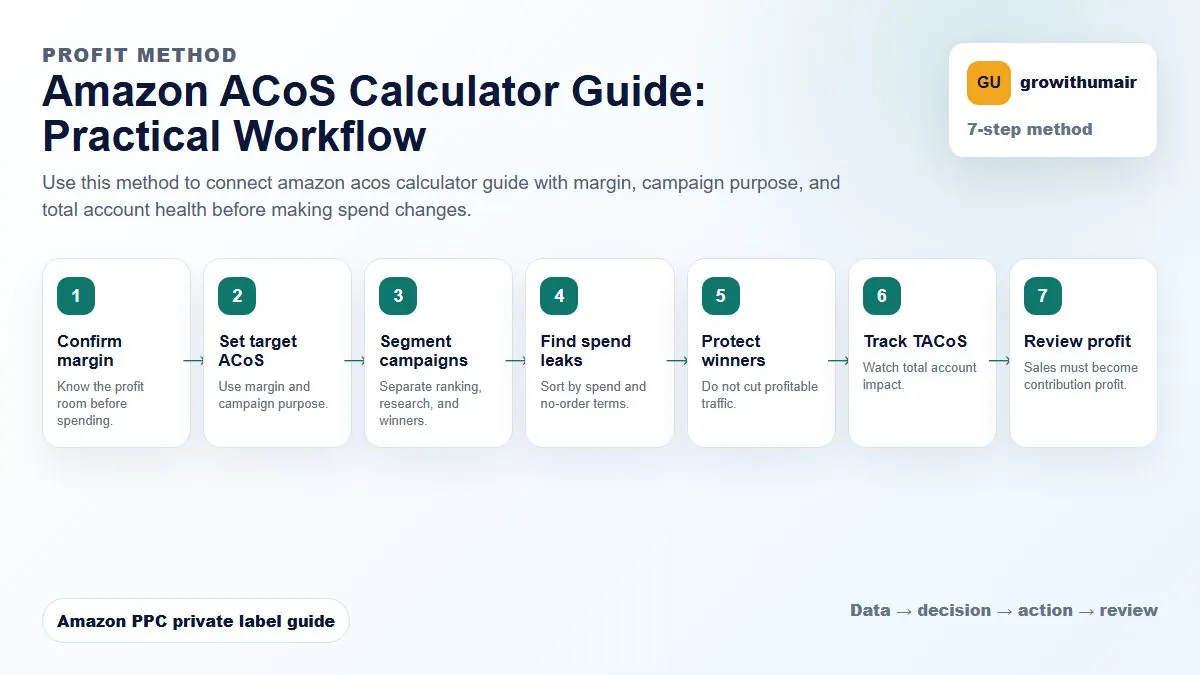
Use this method to connect amazon acos calculator guide with margin, campaign purpose, and total account health before making spend changes. The aim is to move from raw Amazon Ads data to a written action list: what to protect, what to reduce, what to test, and what to review again.
- 1. Confirm margin: Know the profit room before spending.
- 2. Set target ACoS: Use margin and campaign purpose.
- 3. Segment campaigns: Separate ranking, research, and winners.
- 4. Find spend leaks: Sort by spend and no-order terms.
- 5. Protect winners: Do not cut profitable traffic.
- 6. Track TACoS: Watch total account impact.
- 7. Review profit: Sales must become contribution profit.
How to choose the next action
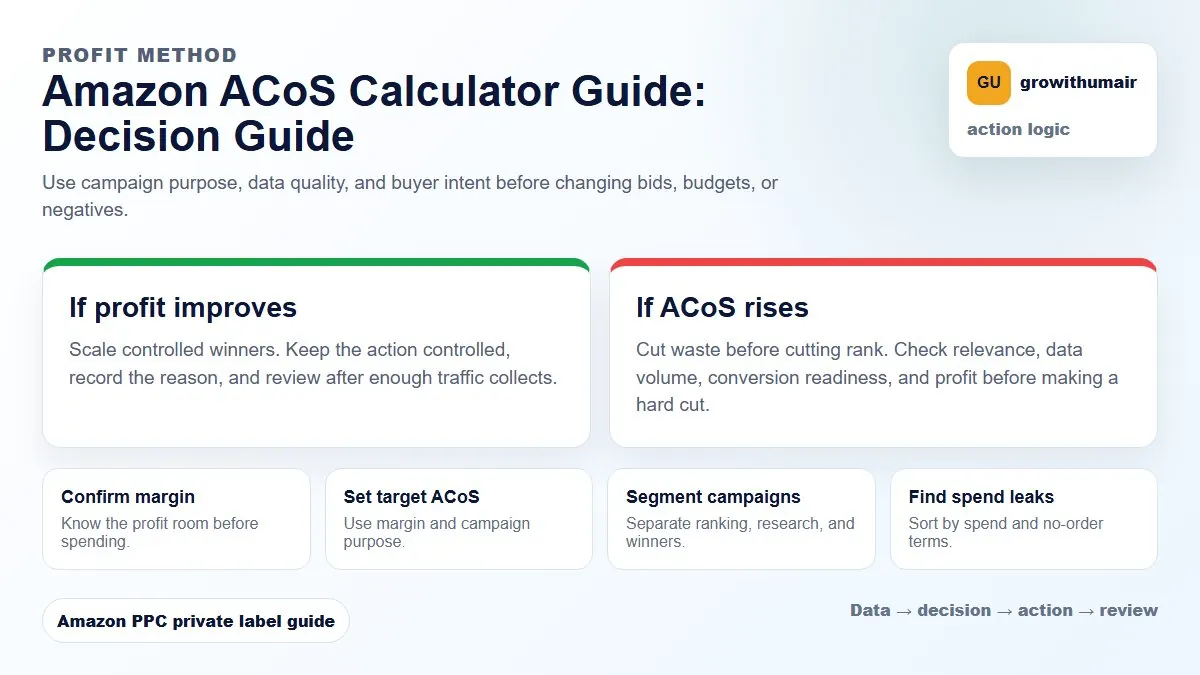
Do not treat one metric as the whole answer. For every change, read the metric beside campaign purpose, search intent, listing readiness, rank movement, and profit. This prevents cutting useful traffic just because one report looks uncomfortable.
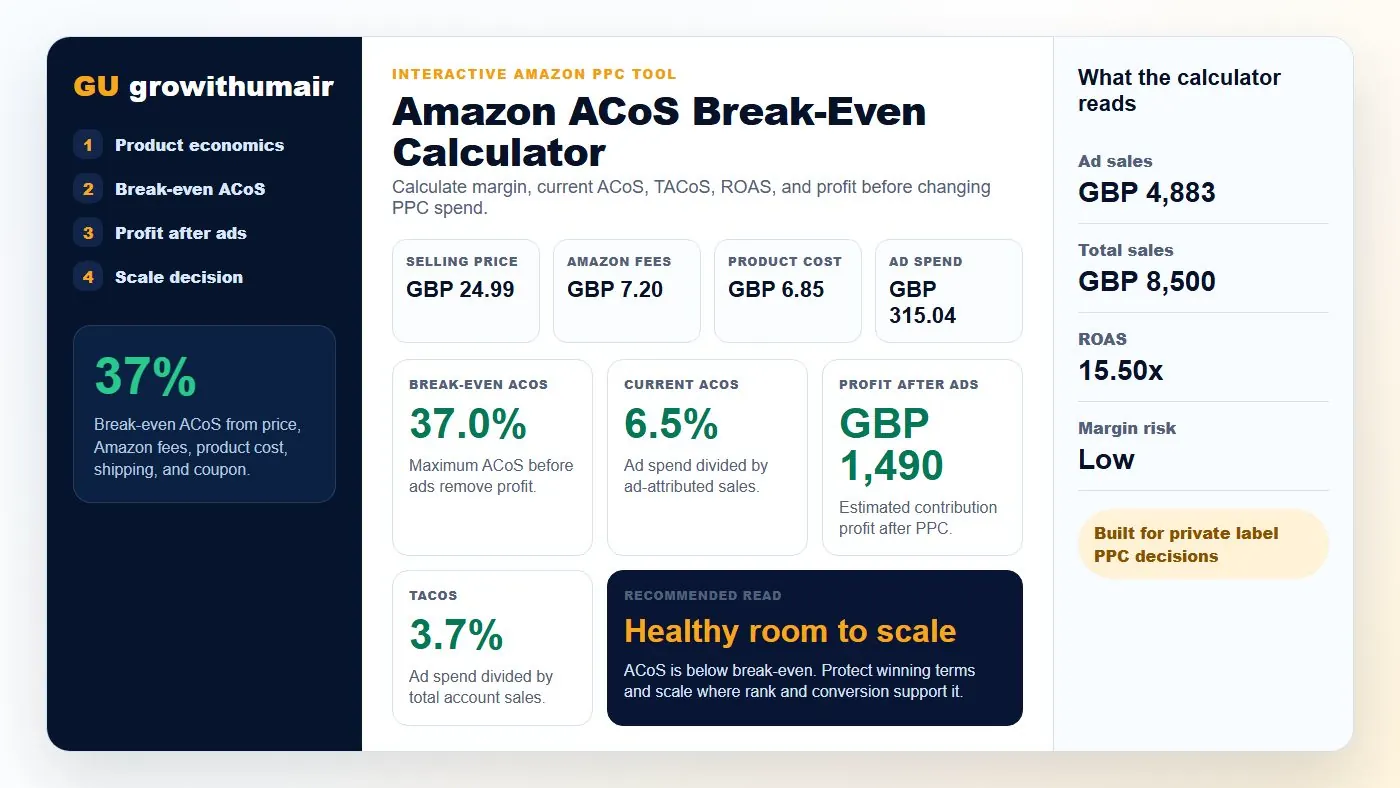
ACoS = ad spend divided by ad sales. If you spend GBP 315.04 and generate GBP 4,883.19 in ad sales, ACoS is about 6.45%. The number is only meaningful after you compare it with product margin.
What is Amazon ACoS?
Amazon ACoS means advertising cost of sales. It tells you what percentage of ad-attributed revenue was spent on ads. A low ACoS usually means efficient campaigns, but it does not always mean the account is healthier. During a launch, a seller may accept a higher ACoS to win ranking, collect sales velocity, or test keyword demand.
How to calculate break-even ACoS
Break-even ACoS is the highest ACoS you can pay before the ad sale stops being profitable. Start with selling price, Amazon fees, product cost, freight, prep, storage, returns, and any coupon or discount. The remaining margin percentage is your rough break-even ACoS.
Interactive tool
Amazon break-even ACoS calculator
Enter your product economics and PPC numbers to see whether your current ads are below break-even, close to margin pressure, or losing money.
Maximum ACoS before the ad sale stops being profitable.
What is a good ACoS on Amazon?
A good ACoS is not one fixed number. It depends on your product margin, launch stage, organic rank, review count, price position, and the job of each campaign. A mature product with stable organic ranking may need ACoS below 20 percent. A new launch may intentionally run 40 to 60 percent ACoS for a short window if the goal is sales velocity and ranking data.
The safest benchmark is your own break-even ACoS. If your product has 37 percent margin after Amazon fees, product cost, shipping, prep, and coupons, then 37 percent is the ceiling where an ad sale stops being profitable. Your target ACoS should usually sit below that ceiling unless the campaign is built for ranking or research.
ACoS vs TACoS: which should you watch?
ACoS measures ad-attributed efficiency. TACoS measures total account health by dividing ad spend by total sales. A seller with GBP 500 in ad sales and GBP 2,000 in total sales is in a very different position from a seller with the same ad sales but only GBP 600 in total sales. ACoS alone cannot show whether PPC is supporting organic rank.
When ACoS rises but TACoS falls, the account may still be getting healthier because organic sales are growing faster than ad spend. When ACoS improves but TACoS rises, ads may look efficient while organic visibility is weakening. That is why this calculator shows ACoS, TACoS, ROAS, and profit together.
What to do if your ACoS is above break-even
- Sort search terms by spend and check terms with clicks but no orders.
- Review listing conversion rate, main image, title relevance, reviews, and price before blaming bids.
- Separate research campaigns from exact winner campaigns so one budget is not carrying every purpose.
- Add negatives for irrelevant search terms before cutting bids on useful ranking terms.
- Recalculate break-even ACoS whenever fees, landed cost, coupon, or shipping changes.
Amazon ACoS calculator FAQ
What is break-even ACoS?
Break-even ACoS is the highest ACoS at which an ad-attributed sale returns zero profit after Amazon fees, product cost, shipping, prep, and discounts.
Is lower ACoS always better?
No. A very low ACoS can mean you are under-spending during a launch or failing to defend ranking keywords. Mature products should be efficient, but launch and ranking campaigns may need a higher target.
What is a good ROAS on Amazon?
A 3x ROAS can be healthy for many products, but the correct target depends on margin. A low-margin product may need much higher ROAS, while a launch campaign may temporarily accept lower ROAS.
How do I improve ACoS without cutting spend?
Fix irrelevant search terms, improve listing conversion, separate research from exact winners, add negatives carefully, and calculate break-even ACoS before changing budgets.
Ad spend divided by ad-attributed sales.
Estimated contribution profit from ad-attributed sales.
Ad spend divided by total account sales.
Ad sales divided by ad spend.
Use real cost numbers before scaling spend.
| Metric | Example | Why it matters |
|---|---|---|
| Selling price | GBP 24.99 | Revenue before costs. |
| All product and Amazon costs | GBP 15.75 | Includes landed cost, fees, and handling. |
| Profit before ads | GBP 9.24 | The money available before advertising. |
| Break-even ACoS | 36.9% | Above this point the ad sale loses money. |
Target ACoS is not always break-even ACoS
Target ACoS should depend on the campaign job. A branded defense campaign may need a very low target. A ranking campaign for a new product may run closer to break-even for a controlled period. A research campaign may run above target if it is finding useful exact-match winners.
Read ACoS with profit, TACoS, and rank
If ACoS drops because sales volume collapses, that is not a win. Look at TACoS, organic sales share, keyword rank, conversion rate, and total profit. The goal is not a pretty ACoS screenshot. The goal is profitable growth with enough visibility to keep sales stable.
What to do after calculating ACoS
- Separate campaigns by purpose: ranking, harvesting, defense, exact scaling, and product targeting.
- Set different target ACoS ranges for each purpose.
- Review wasted spend before reducing budgets on campaigns that are supporting rank.
- Use this ACoS reduction guide to decide what to fix first.