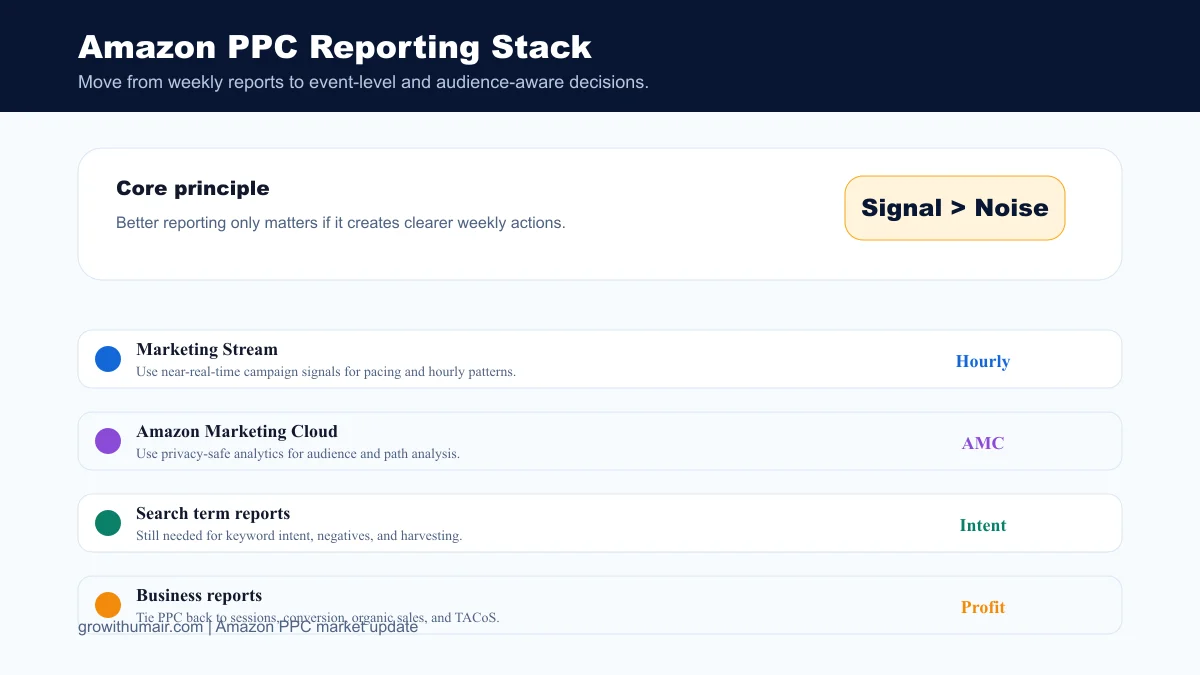
Amazon PPC reporting is moving beyond weekly campaign tables. Marketing Stream and Amazon Marketing Cloud can help sellers understand timing, audiences, path-to-purchase, and campaign impact with more detail.
What is changing
Amazon advertisers now have more reporting options than the standard campaign manager tables. Marketing Stream focuses on campaign data signals that can be used closer to real time. Amazon Marketing Cloud is built for deeper, privacy-safe analytics across audiences, paths, and media impact.
Why this matters for private label sellers
Many sellers still optimize from delayed, blended reports. That means they cut bids without knowing timing, placement, path, or organic impact. Better reporting helps separate research spend from scaling spend, discover weak timing windows, and understand whether ads are supporting total account growth.
When Marketing Stream is useful
Marketing Stream is useful when campaigns have enough spend and the account needs tighter pacing control. It can help identify budget waste earlier, understand hourly swings, and support dayparting decisions. It is less useful for very small accounts where daily data is already thin.
When AMC is useful
AMC is useful when sellers need bigger-picture analysis: how Sponsored Products, Sponsored Brands, Sponsored Display, audiences, and Stores contribute to purchase behavior. This matters more as spend grows, because last-click ACoS alone can undervalue awareness and brand defense.
What sellers should do now
Even if you are not ready for AMC, build reporting habits that prepare you for it: clean campaign naming, consistent portfolio structure, clear product groups, weekly action logs, and separation between research, ranking, defense, and exact scaling campaigns.
Step-by-step action plan
- 1. Clean campaign naming so reports are readable.
- 2. Separate campaign purpose before analyzing timing or audience data.
- 3. Track weekly action logs beside performance.
- 4. Use Marketing Stream for pacing only when spend volume supports it.
- 5. Use AMC questions only when there is a real decision to make.
How this connects to PPC performance
For Amazon private label sellers, the point is not to chase every new feature. The point is to use new features only when they improve one of the core PPC decisions: which traffic to buy, which keyword to protect, which listing signal to improve, which campaign to scale, and which spend to stop.
| Decision | Metric to watch | Useful action |
|---|---|---|
| Creative or message change | CTR and conversion rate | Keep changes that attract buyers, not just clicks. |
| Budget increase | TACoS and profit | Scale only where total account health improves. |
| Ranking support | Organic rank and orders | Protect terms that create rank movement. |
| Waste cleanup | Spend with zero orders | Add negatives or reduce exposure with context. |
Amazon Marketing Cloud and Marketing Stream: How PPC Reporting Is Changing FAQ
Is this important for every Amazon seller?
It is most important for active private label sellers with live PPC campaigns, launch plans, or enough spend to test changes properly.
What should I avoid?
Avoid changing creative, budgets, bids, and listings all at once. If every variable changes together, the result cannot teach you what worked.
Can this lower ACoS?
It can help lower ACoS when it improves search intent, conversion rate, budget allocation, or campaign structure. It will not fix poor listings or irrelevant targeting by itself.