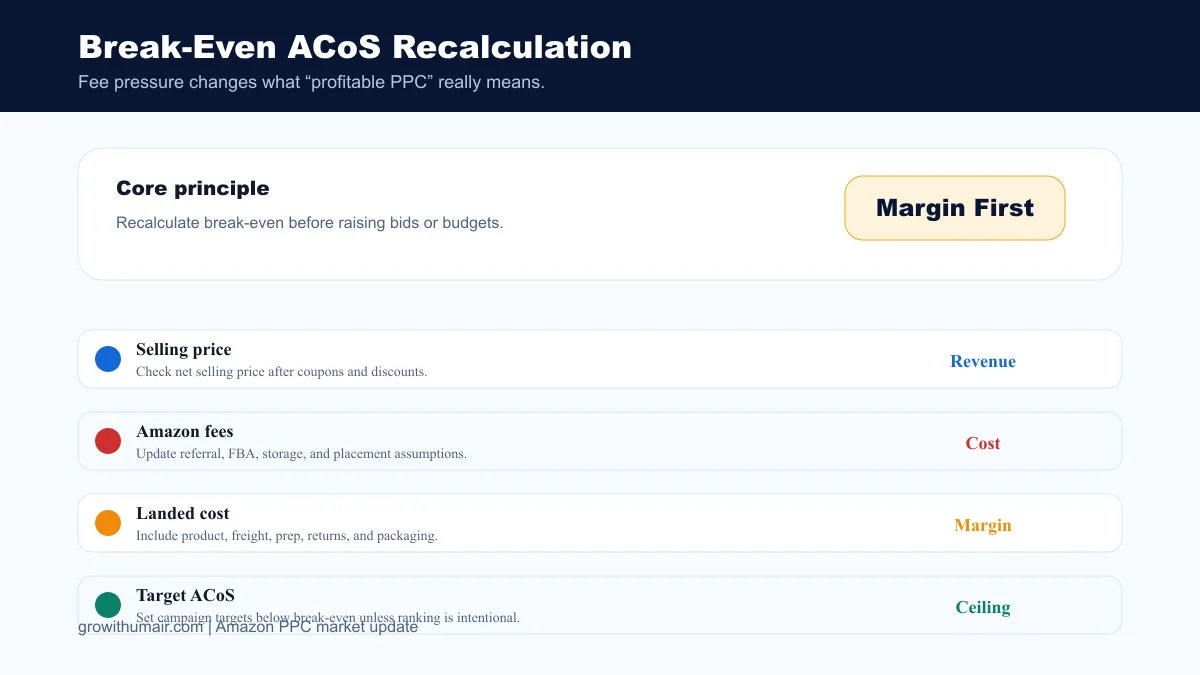
PPC decisions are only as good as the margin behind them. When FBA fees, storage, placement, shipping, and landed cost change, your old target ACoS can become dangerous.
Why this matters now
Private label sellers often keep the same PPC targets for months while product economics change underneath them. A product that was safe at 30 percent ACoS can become risky if fees, coupons, placement costs, or landed cost rise.
What to recalculate
Start with selling price, referral fee, FBA fulfillment fee, inbound placement or shipping assumptions, storage, prep, returns, product cost, freight, and coupons. Do not calculate ACoS targets from sales alone. Calculate them from contribution margin.
How this changes PPC decisions
If break-even ACoS falls, exact winner campaigns may still be worth protecting, but research campaigns need tighter limits. Product targeting and broad discovery should be reviewed harder because they often carry weaker conversion rates.
When high ACoS is still acceptable
A campaign can run close to break-even during a launch, rank push, or key seasonal period if TACoS and organic rank are improving. The key is writing down why the campaign is allowed to run high and when it will be reviewed.
How often to update targets
Update break-even ACoS at least monthly for active ASINs, and immediately after fee changes, price changes, coupon changes, shipping changes, or supplier cost changes.
Step-by-step action plan
- 1. Recalculate product margin by ASIN.
- 2. Set break-even ACoS and target ACoS separately.
- 3. Label campaigns by purpose: research, ranking, exact scale, defense.
- 4. Cut waste from search terms before cutting ranking traffic.
- 5. Review TACoS and profit after every major budget increase.
How this connects to PPC performance
For Amazon private label sellers, the point is not to chase every new feature. The point is to use new features only when they improve one of the core PPC decisions: which traffic to buy, which keyword to protect, which listing signal to improve, which campaign to scale, and which spend to stop.
| Decision | Metric to watch | Useful action |
|---|---|---|
| Creative or message change | CTR and conversion rate | Keep changes that attract buyers, not just clicks. |
| Budget increase | TACoS and profit | Scale only where total account health improves. |
| Ranking support | Organic rank and orders | Protect terms that create rank movement. |
| Waste cleanup | Spend with zero orders | Add negatives or reduce exposure with context. |
Amazon FBA Fee Pressure in 2026: How to Recalculate Break-Even ACoS FAQ
Is this important for every Amazon seller?
It is most important for active private label sellers with live PPC campaigns, launch plans, or enough spend to test changes properly.
What should I avoid?
Avoid changing creative, budgets, bids, and listings all at once. If every variable changes together, the result cannot teach you what worked.
Can this lower ACoS?
It can help lower ACoS when it improves search intent, conversion rate, budget allocation, or campaign structure. It will not fix poor listings or irrelevant targeting by itself.