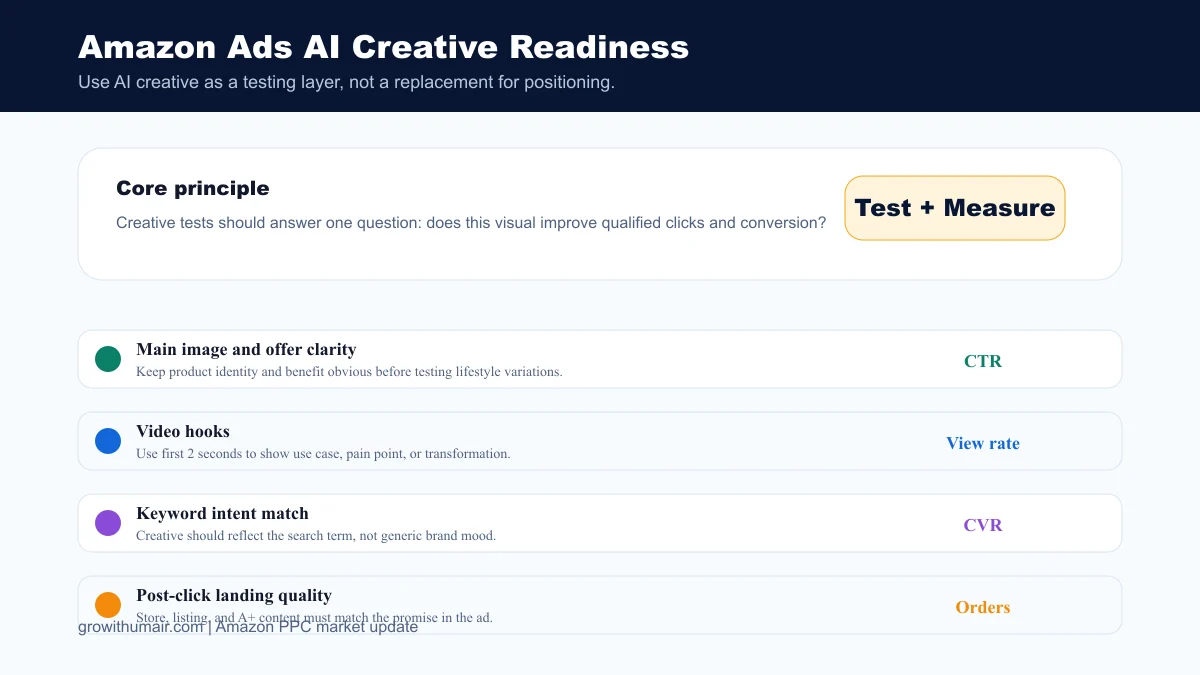
Amazon Ads AI creative is useful, but only when it is tied to listing strategy, keyword intent, and conversion data. This guide explains how private label sellers should test AI-generated creative without turning PPC into a design experiment.
What changed
Amazon Ads has been pushing more AI-assisted creative workflows for advertisers, especially around faster creative production, video-style assets, and campaign-ready variations. For private label sellers, the practical opportunity is not “make more creatives.” The opportunity is to test stronger product positioning faster: pain point, use case, comparison angle, benefit proof, and seasonal offer.
Where sellers should use AI creative first
Start with Sponsored Brands video concepts, Store hero assets, lifestyle image variations, and seasonal message tests. Do not start by replacing your main image or changing every campaign at once. The safest workflow is to keep the listing stable, create 2 or 3 creative angles, and test them against the same campaign purpose.
The mistake to avoid
Many sellers will use AI creative to create attractive images that do not match search intent. A beautiful lifestyle asset can still perform badly if shoppers cannot quickly understand the product, size, material, compatibility, or use case. PPC creative must reduce buyer doubt, not just look polished.
A practical testing method
Pick one ASIN, one campaign type, and one creative question. For example: does a use-case video beat a product-only video for Sponsored Brands? Run the test long enough to compare CTR, view rate, CPC, orders, ACoS, and Store/listing conversion. If CTR improves but orders do not, the creative may be attracting curiosity instead of buyers.
What to measure
Track CTR, CVR, ACoS, ROAS, branded vs non-branded traffic, new-to-brand orders where available, and TACoS. Creative success is not just lower CPC. A weaker creative can sometimes have fewer clicks but better buyer intent and stronger conversion.
Step-by-step action plan
- 1. Audit existing creative angles before generating new ones.
- 2. Create 2 or 3 variations based on buyer intent, not decoration.
- 3. Run one test per campaign purpose.
- 4. Compare CTR and CVR together.
- 5. Keep the winning message and rebuild weaker assets around it.
How this connects to PPC performance
For Amazon private label sellers, the point is not to chase every new feature. The point is to use new features only when they improve one of the core PPC decisions: which traffic to buy, which keyword to protect, which listing signal to improve, which campaign to scale, and which spend to stop.
| Decision | Metric to watch | Useful action |
|---|---|---|
| Creative or message change | CTR and conversion rate | Keep changes that attract buyers, not just clicks. |
| Budget increase | TACoS and profit | Scale only where total account health improves. |
| Ranking support | Organic rank and orders | Protect terms that create rank movement. |
| Waste cleanup | Spend with zero orders | Add negatives or reduce exposure with context. |
Amazon Ads AI Creative Updates: What Private Label Sellers Should Do in 2026 FAQ
Is this important for every Amazon seller?
It is most important for active private label sellers with live PPC campaigns, launch plans, or enough spend to test changes properly.
What should I avoid?
Avoid changing creative, budgets, bids, and listings all at once. If every variable changes together, the result cannot teach you what worked.
Can this lower ACoS?
It can help lower ACoS when it improves search intent, conversion rate, budget allocation, or campaign structure. It will not fix poor listings or irrelevant targeting by itself.