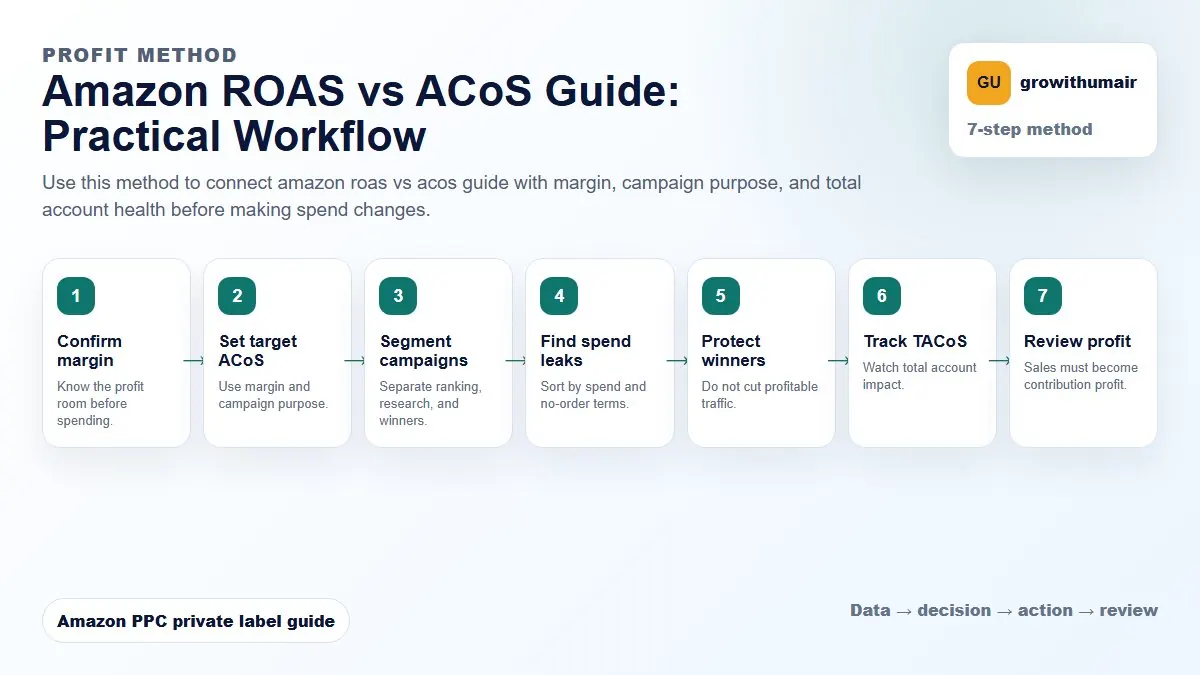
Amazon ROAS vs ACoS Guide: step-by-step method
Use this method to connect amazon roas vs acos guide with margin, campaign purpose, and total account health before making spend changes. The aim is to move from raw Amazon Ads data to a written action list: what to protect, what to reduce, what to test, and what to review again.
- 1. Confirm margin: Know the profit room before spending.
- 2. Set target ACoS: Use margin and campaign purpose.
- 3. Segment campaigns: Separate ranking, research, and winners.
- 4. Find spend leaks: Sort by spend and no-order terms.
- 5. Protect winners: Do not cut profitable traffic.
- 6. Track TACoS: Watch total account impact.
- 7. Review profit: Sales must become contribution profit.
How to choose the next action
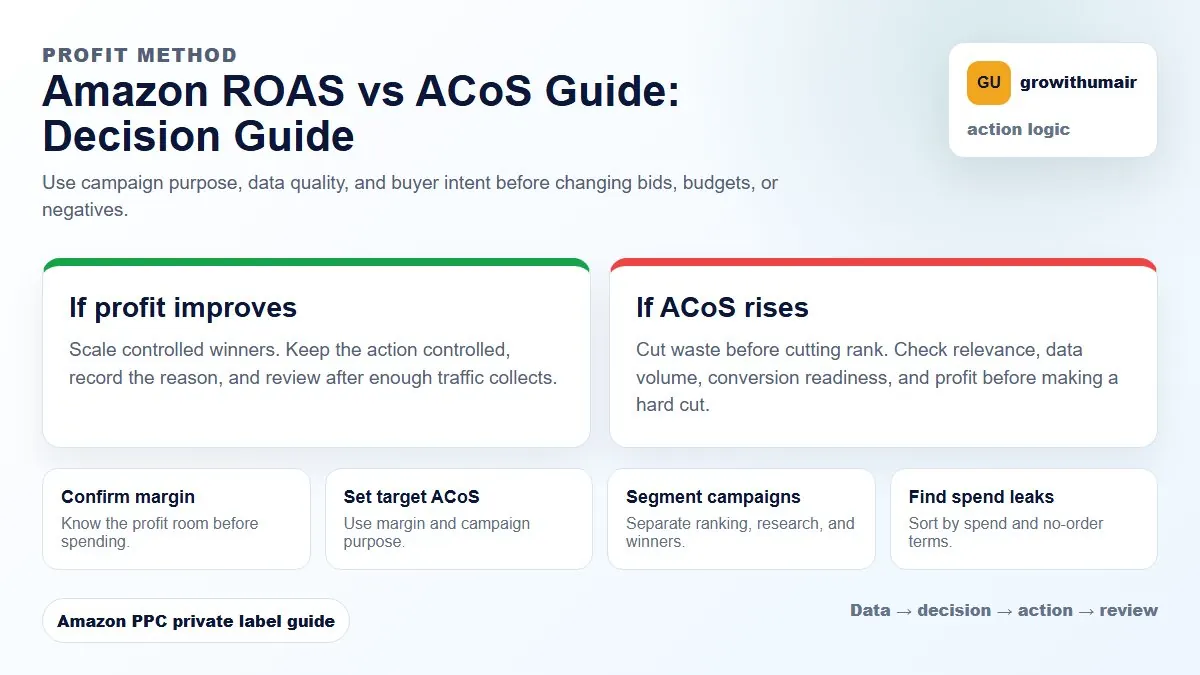
Do not treat one metric as the whole answer. For every change, read the metric beside campaign purpose, search intent, listing readiness, rank movement, and profit. This prevents cutting useful traffic just because one report looks uncomfortable.
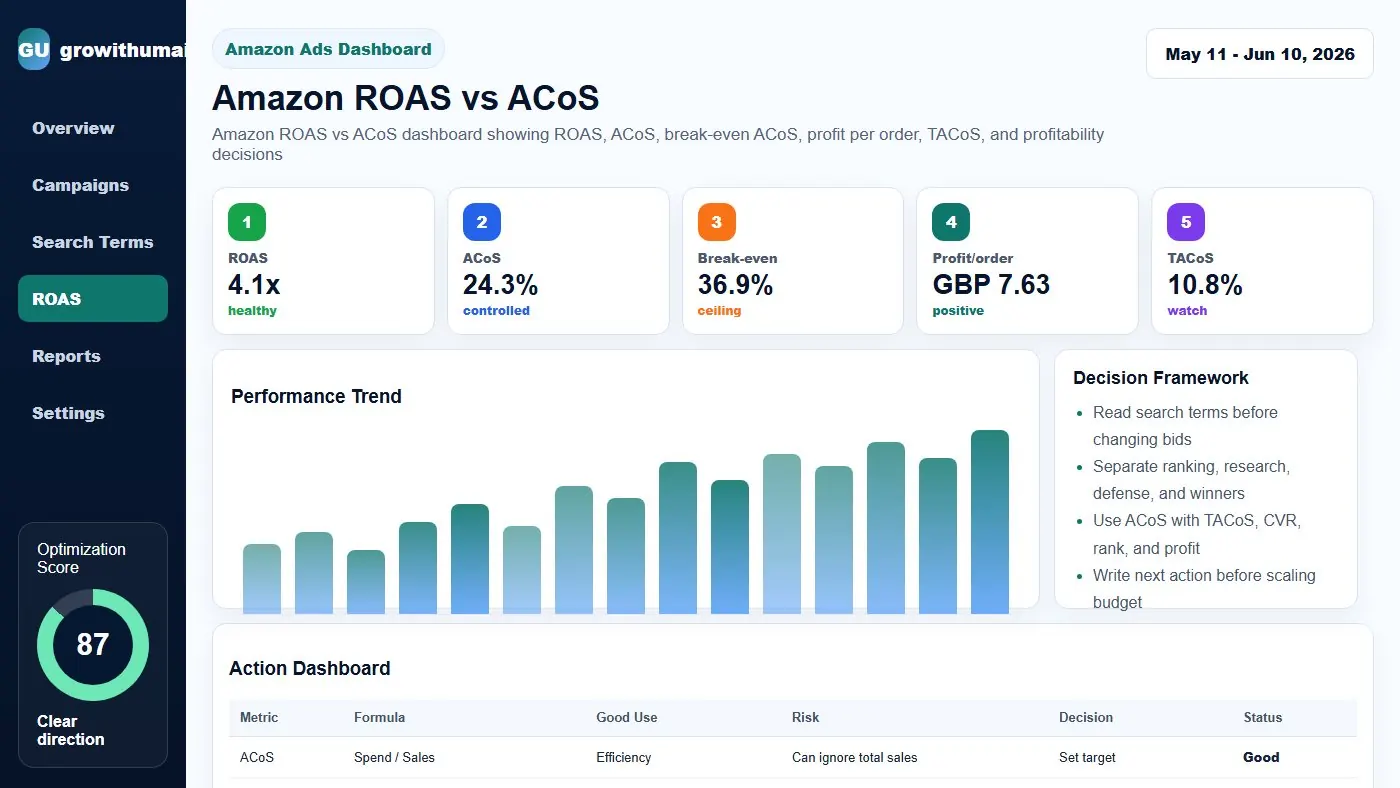
ACoS = ad spend divided by ad sales. ROAS = ad sales divided by ad spend. A 25% ACoS equals 4x ROAS.
What ACoS means
ACoS shows how much of your ad sales are consumed by ad spend. If you spend GBP 25 to generate GBP 100 in ad sales, ACoS is 25%. Lower ACoS usually looks better, but low ACoS is not always the best goal during launch or ranking campaigns.
What ROAS means
ROAS shows how much revenue you get for every pound spent on ads. If you spend GBP 25 and generate GBP 100, ROAS is 4x. Some teams prefer ROAS because it reads like a return number. Amazon sellers often use ACoS more because it connects directly to margin.
| Metric | Formula | Example | Meaning |
|---|---|---|---|
| ACoS | Ad spend / ad sales | GBP 25 / GBP 100 = 25% | Cost percentage |
| ROAS | Ad sales / ad spend | GBP 100 / GBP 25 = 4x | Revenue return |
| TACoS | Ad spend / total sales | GBP 25 / GBP 250 = 10% | Total account ad pressure |
Why margin matters
A 25% ACoS can be profitable for one product and unprofitable for another. If your break-even ACoS is 35%, a 25% ACoS may be healthy. If your break-even ACoS is 18%, the same campaign may be losing money.
Use break-even ACoS before deciding whether ROAS or ACoS is good. Campaign metrics without margin are incomplete.
When ROAS can mislead you
A high ROAS campaign may only be branded defense that would have converted anyway. A lower ROAS campaign may be helping you rank for an important non-branded keyword. This is why you should read ROAS, ACoS, TACoS, rank movement, and organic sales share together.
Which one should Amazon sellers use?
Use both if your team understands them, but make decisions using ACoS, TACoS, profit margin, and campaign purpose. ROAS is useful for quick reporting. ACoS is often more practical for PPC optimization because it connects directly with spend control and margin ceiling.
- Use ACoS for campaign profitability.
- Use ROAS for return-style reporting.
- Use TACoS for total account health.
- Use margin to define what is actually profitable.
- Use rank tracking to understand strategic spend.
Send selling price, landed cost, Amazon fees, ad spend, and ad sales. I will show your break-even ACoS and target range.
Book an audit