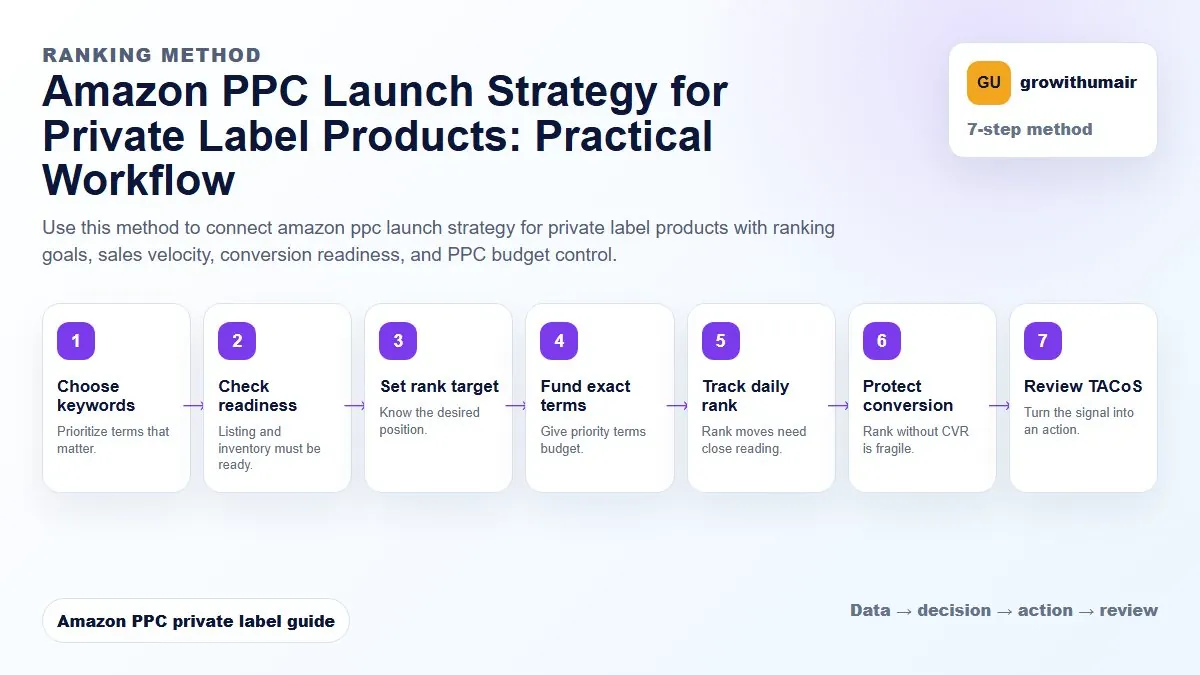
Amazon PPC Launch Strategy for Private Label Products: step-by-step method
Use this method to connect amazon ppc launch strategy for private label products with ranking goals, sales velocity, conversion readiness, and PPC budget control. The aim is to move from raw Amazon Ads data to a written action list: what to protect, what to reduce, what to test, and what to review again.
- 1. Choose keywords: Prioritize terms that matter.
- 2. Check readiness: Listing and inventory must be ready.
- 3. Set rank target: Know the desired position.
- 4. Fund exact terms: Give priority terms budget.
- 5. Track daily rank: Rank moves need close reading.
- 6. Protect conversion: Rank without CVR is fragile.
- 7. Review TACoS: Turn the signal into an action.
How to choose the next action
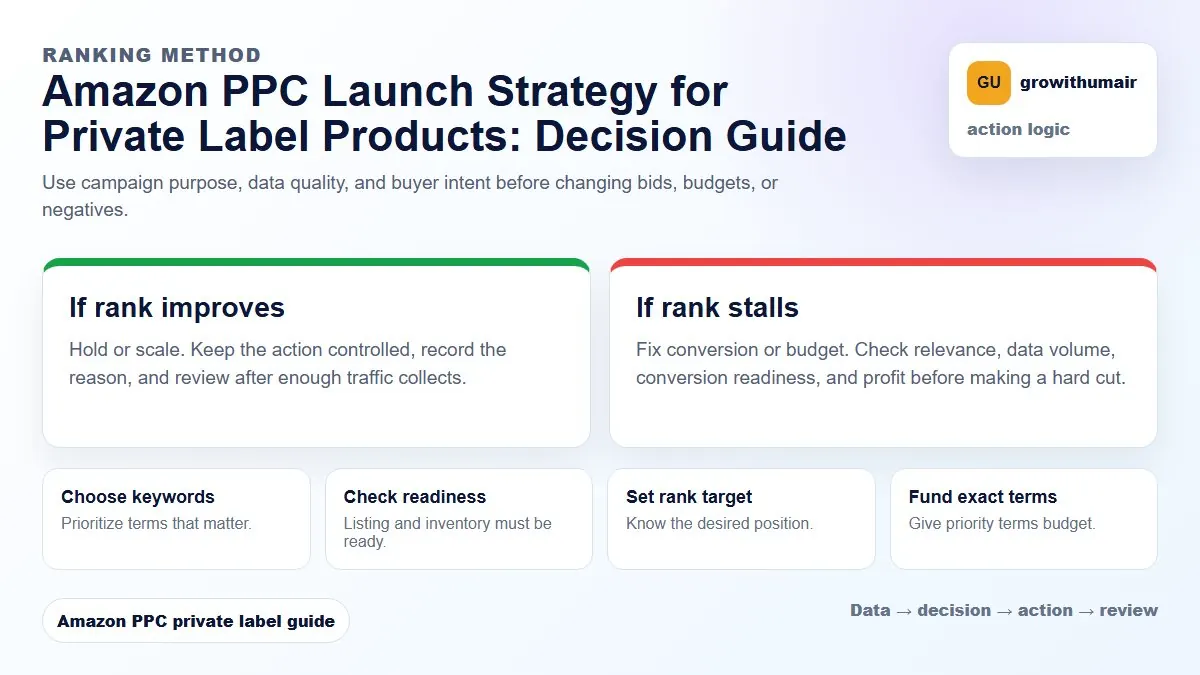
Do not treat one metric as the whole answer. For every change, read the metric beside campaign purpose, search intent, listing readiness, rank movement, and profit. This prevents cutting useful traffic just because one report looks uncomfortable.
Do not launch with ads only. Launch with a prepared listing, keyword map, campaign structure, budget plan, and rank tracking sheet.
Start before the first ad goes live
A launch campaign cannot fix a weak offer. Before spending, check title relevance, bullet clarity, main image, price, coupon, reviews plan, inventory, and keyword indexing. If the listing is not ready, PPC will buy traffic that does not convert.
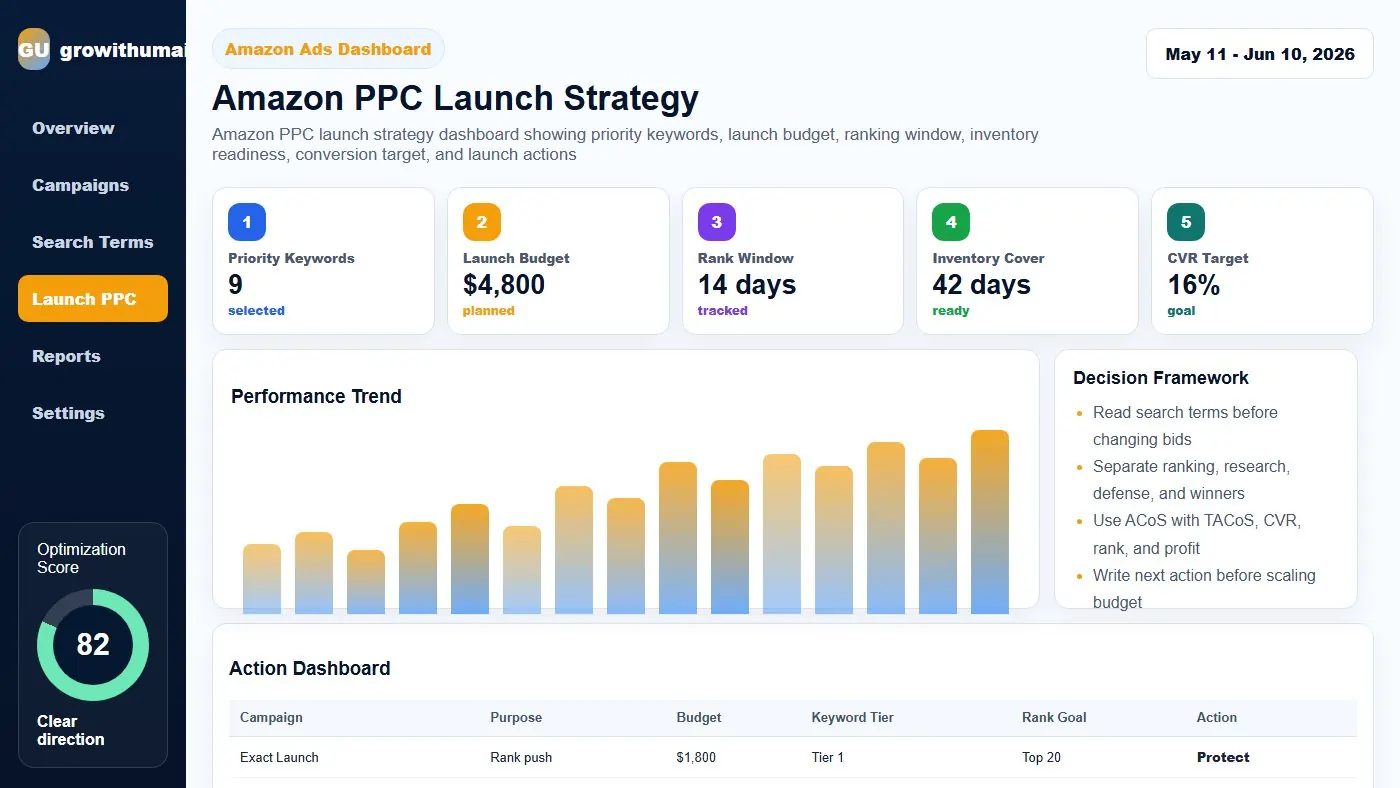
Build a keyword list with three levels: core ranking keywords, secondary conversion keywords, and research terms. Core ranking keywords deserve the cleanest campaigns and budget. Research terms should collect data without stealing too much spend.
Campaign structure for launch
| Campaign | Purpose | Budget logic |
|---|---|---|
| Exact core keywords | Push priority search terms | Protected daily budget |
| Phrase discovery | Find close variations | Moderate budget |
| Auto campaign | Mine search terms and ASINs | Controlled budget |
| Product targeting | Compete on relevant ASINs | Small test budget |
How aggressive should launch ACoS be?
Launch ACoS is often higher than mature account ACoS because you are buying data and initial ranking support. That does not mean every high ACoS campaign is acceptable. Judge launch PPC beside TACoS, organic rank movement, conversion rate, and total sales velocity.
If ACoS is high but ranking improves and organic sales start building, the spend may be strategic. If ACoS is high, rank is flat, and conversion is poor, the launch is leaking. Use the ACoS calculator to understand profit limits.
Post-launch cleanup
After 14 to 30 days, pull search term reports. Harvest converting terms into exact campaigns, add negatives for irrelevant spend, reduce bids where clicks do not convert, and protect keywords that are supporting rank. A launch account should become cleaner every week.
- Track organic rank for core keywords.
- Review TACoS weekly, not only ACoS.
- Keep exact winners funded.
- Control auto and phrase campaigns with negatives.
- Fix listing issues before adding more budget.
Send the ASIN, marketplace, and launch date. I can map the PPC structure and rank targets before spend starts.
Book an audit